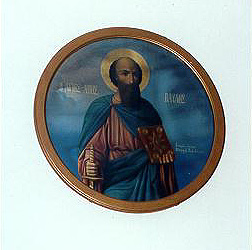
A N Wilson comes across as the model accessible academic. His arguments are clear and concise, his logic explained, his assumptions clearly stated. But, for a non-linguist like me, the casual explanation of original Greek idioms are just so impressive. Across this book, you really do get the impression that Wilson knows the culture he is talking about. And whatever else may be unclear, that Paul was Jew of the Diaspora and the Hellenic world is surely the sole certainty.
Unlike Jesus, we do have some remnants of Paul’s original writing; beyond that, it is difficult to say anything very much with certainty. Who was Paul, why did he become so obsessed about Jesus? How did he come up with his distinctive twist on the meaning of the Cross? And what did he really think about the Jerusalem Church, the friends and relatives of the real Jesus?
Those who have read these articles before will not need the essentials re-stating – that Jesus was a Jew who had no intention of creating a new church. Indeed, since he was sure the end times were imminent, such an idea would have been ridiculous. After he died, his disciples continued to lead a Jesus sect within the Jerusalem temple, under the leadership of his brother James. Paul became the self-selected ‘apostle to the gentiles’, and who knows how successful an enterprise this would have been had it not been for the destruction of Rome in 66-70, which had the chance effect of wiping out the Jerusalem Church leaving the ‘Christ’ of the Diaspora and the gentiles as the ‘true’ Christianity.
Paul is generally claimed to be the true inventor of Christianity, and while this is true, like Jesus he had no interest in starting a Church, because again he knew that the world was almost at an end. Jesus was to return ‘imminently’ and the Saints would be raised. The ‘Christians’ would be the first to be raised up to Heaven. Paul’s manic energy and drive was a desire to ‘save’ as many souls as he could before Jesus returned…
But we leap ahead. Paul is introduced into the Jesus story after the resurrection with his ‘apocalypse’ on the way to Damascus. What do we know of Paul? That he was educated a Pharisee, had worked in the temple guard and was ‘persecuting’ ‘Christians’. Plenty to keep us going there. As a temple guard, was he present when Jesus was arrested? Or even when he was crucified? Could it be that his own part in killing the anointed one led him to dedicate his life to correcting this terrible, personal calamity?
After his apocalypse, Paul went away to Arabia for three years, and after a gap of seventeen years, starts to preach about Jesus in his native Tarsus. Another interesting question. Just what was he doing all those years? If the apocalypse was a overwhelming as he tells people, how come it took so long to do anything about it?
Paul goes to Jerusalem to see James and the apostles. How do they react to this man who was their enemy, but who now reveres Jesus, but has strange ideas about him? Presumably he is given a fairly dusty answer, but as he is willing to collect money for the poor Jerusalem church his enthusiasm is enlisted, and he is given permission to preach to The God Fearers – gentiles who try to live their lives as closely to the Jewish model as possible.
Whereas Jesus himself was a solidly traditional Jew – zealous for the Law – Paul has worked out that faith in Jesus is the secret to salvation in the imminent end times, not being circumcised, or following complex dietary laws. Accordingly he is not worried about these details, will eat with anyone and does not demand the horrifically gruesome act of circumcision on adult converts. Unsurprisingly he causes trouble wherever he goes. To follow Paul’s trips around Asia Minor is to follow a trail of riots and prison sentences. Here he is lashed by the ‘Jews’ there he is locked up by the Romans…
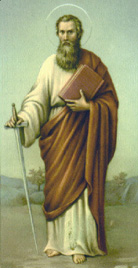
Despite the survival of Paul’s letters, the ‘story’ of Paul is told in Acts, by the writer Luke. Luke wrote the Acts of the Apostles specifically for one man , Theophilus. It is not a neutral document, let alone anything that we might today recognise as History. While we do not know what Luke’s purpose was, we do know that he was desperate to show Theophilus that ‘Christians’ were anti Jew, pro-Rome. Hence the use of the word Jews in a way that neither Paul nor Jesus could conceivably have recognised, and a general toning down of Paul’s essentially revolutionary message. The Acts of the Apostles is a story written specifically to placate a Roman audience, so it is rather flawed as a historical document. The differences between Paul’s activities as described in Acts and Paul’s own description of those events is instructive.
Even Luke cannot gloss over the huge row between Paul and Peter over the dietary laws in Antioch. In a passage which paints Peter as a vacillating and weak man, Paul snubs the brother of the Lord in the total belief that he is right and is fulfilling the desires of Jesus. Indeed, Paul comes to see the views of the apostles as limited and un-ambitious. It is he, the apostle who knew Jesus only after the resurrection who truly understands the significance of that resurrection.
Paul was a tentmaker, and Wilson assumes him to have been the owner of a major company making large tents for the Romans. Paul is very proud of the fact that he supports his missionary activities by his own hands, and never has to beg. He uses his business contacts to deliver his epistles, to find places to stay in new lands and is generally confident about travelling around the Roman world. Nonetheless he returns to Jerusalem one last time, and yet again there is trouble. He is arrested again, and claims an appeal to Caesar by virtue of his Roman Citizenship. A final traumatic journey, another shipwreck (Paul seems not to have been a lucky traveller) and the journey finishes in a frustrating void.
Did he ever get his hearing? Did he travel on to Spain, his planned destination, so that he could claim to have preached the word of Jesus in all the world, so fulfilling one of the necessary criteria for Jesus’ return? Was he imprisoned or did he live out his days preaching in the chaotic mayhem that was ancient Rome?
It seems unlikely that ‘Christianity’ could have existed without Paul. The Jerusalem Church, narrow and blinkered orthodox Jews, was unlikely to find a formula that would appeal to all nations and religions in the way in which Paul could. Their horizons were much more limited, their aims more narrowly defined. For whatever reason it seems that Paul was able to interpret the story of Jesus in a way which the mainstream Hellenic culture of the Roman world found appealing and eventually irresistible.