Never so Good
by Howard Brenton
 One
of our recent themes for discussion has been the lack of substance of modern
politicians. They seem to have done nothing, had no lives outside of
politics, and be largely nonentities compared to the political generation we
grew up with. This prejudice receive a severe endorsement by watching the
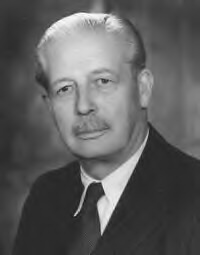
new Howard Brenton play, Never So Good about the life of
Harold Macmillan. Whatever you may think of their politics, there is not
doubt that Macmillan, Neville Chamberlain, Winston Churchill and Anthony
Eden were all men who had lives, personalities and foibles, but also courage
and ideals.
One
of our recent themes for discussion has been the lack of substance of modern
politicians. They seem to have done nothing, had no lives outside of
politics, and be largely nonentities compared to the political generation we
grew up with. This prejudice receive a severe endorsement by watching the
new Howard Brenton play, Never So Good about the life of
Harold Macmillan. Whatever you may think of their politics, there is not
doubt that Macmillan, Neville Chamberlain, Winston Churchill and Anthony
Eden were all men who had lives, personalities and foibles, but also courage
and ideals.
Brenton’s
play presents Macmillan’s life in four acts, starting with the First World
War, where he sets out his thesis. Macmillan although injured five times,
did not die as virtually his entire generation did. The play suggests that
Macmillan never recovered from the guilt of survival, and indeed his young
army self accompanies Jeremy Irons' older politician for the rest of the
play, a constant alter ego, reminding us all of who and what he might have
been. The first act also sets up the doubts about his sexuality. There is
some question about exactly why he was removed from Eton, and his fearsome
American mother is very determined to prevent his seeing his guru teacher,
who is pushing the young man certainly towards Catholicism, and maybe
homosexuality.
 This
theme is strengthened when we rejoin the story at Munich, and his wife
Dorothy declares the reason for her long-standing affair with Bob Boothby
was that her husband ‘did not fuck her!’. Did he or didn’t he? Was he
homosexual or just non-sexual? We don’t know, but the play suggests that
these are important questions. Macmillan is weak/strong enough to join
forces with his wife’s lover and Churchill in opposition to Chamberlain’s
appeasement policy, and he is rewarded with being made the British
Representative for the Allies in North Africa. A first half which has gone
at breakneck speed with multiple superb effects ends on the dramatic
airplane crash which allowed Macmillan to escape death again. Macmillan
finally agrees with his ever-present younger self that now he will stop
being content to be number 2, but go for ‘it'. There is not point
cheating death again if you are not going to strive for the highest
achievement.
This
theme is strengthened when we rejoin the story at Munich, and his wife
Dorothy declares the reason for her long-standing affair with Bob Boothby
was that her husband ‘did not fuck her!’. Did he or didn’t he? Was he
homosexual or just non-sexual? We don’t know, but the play suggests that
these are important questions. Macmillan is weak/strong enough to join
forces with his wife’s lover and Churchill in opposition to Chamberlain’s
appeasement policy, and he is rewarded with being made the British
Representative for the Allies in North Africa. A first half which has gone
at breakneck speed with multiple superb effects ends on the dramatic
airplane crash which allowed Macmillan to escape death again. Macmillan
finally agrees with his ever-present younger self that now he will stop
being content to be number 2, but go for ‘it'. There is not point
cheating death again if you are not going to strive for the highest
achievement.
If the
second half never quite lives up to the pace and pyrotechnics of the first,
it can only be said that Suez has always been a difficult subject to
tackle. Difficult here, as Eden cracks under the strain of lying to our
closest – and entirely vital – ally. I have never understood how the
Government thought it could get away with Suez, and this doesn’t help. But
it does show how Macmillan finally became not only ‘it’, but Supermac as
well. The end is predictable and rather sad. After a sweeping election
victory the sixties strikes our hero dead; he does not understand what is
going on, his values are at odds with everyone else and he literally cannot
attune himself to an age of pleasure and licence. Nothing in him has
prepared him for being satirised to his face by Peter Cook. A cancer is
arranged and the last of the Tory Toffs leaves the stage.
While it
was clear that this was early in the run, the lines not as fluent as they
will be an occasional pause when there should have been action, the acting
is excellent and Jeremy Irons performance immense. This is a part worthy of
him, and we plays it to the full. As does Ian McNeice as the mischievous
Churchill and Anna Chancellor as the confused Dorothy. I did read a review
which said that the play could have been more if Brenton strove to do less.
Very true, but I would always hope the playwright will strive to do more.
If you have
the faintest interest in 20th century history, I would book up
now.
Return to
reviews
Return to home page