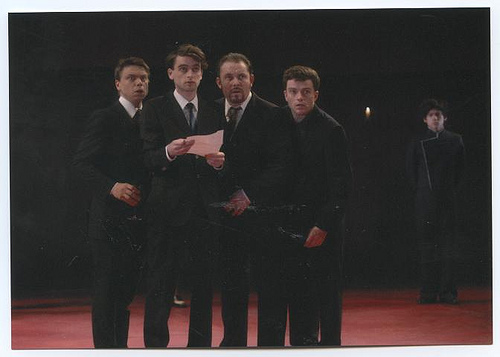
I can't say that I have a good record with Merchant of Venice. I dimly recall a lacklustre National production back in the 70s, and the dire version with Jack Shepherd as Antionio at the Globe about 10 years ago. This was so dire it was all I could do not to shout out that the sooner Shylock got his pound of flesh the sooner we could all go home. It was long, it was dull, it was meaningless. Matthew then did it for GCSE and we had some long debates about whether the concept of anti-semitism meant anything in the sixteenth century. Add to that the last time I visited the RSC in Stratford - admittedly a very long time ago - it was dire production of Midsummer Night's Dream - and that the actual theatre is a building site (I thought they were refurbishing, not demolishing?) and I was a touch tentative about our night out in Stratford.
However, the real portent was much more recent, the
brilliant Richard III at the Roundhouse a few weeks ago. This young, vibrant
and exciting cast gave life to Merchant of Venice,
a play I had considered too stuck in
an historical past to have any relevance to us. Played in modern dress, at
pace and with a young cast who could actually read the text meaningfully,
the three hours hurtled past in a rush. Antonio is a bit of a City lad, but
his heart is in the right place, while Bassanio was a David Tarrant
look-alike, so earnestly in love it hurt. Portia was a thoroughly modern
woman - in control, powerful, competent. And Nerissa her PA, smart suit,
neat hair, always one step ahead of her demanding boss. But despite this
modern awareness, they were trapped by the will of Portia's father and had
to go through the test for the suitors that looked for her hand.
The production was generally stripped and bare, no scenery and no time to involve any. But there was time for some business with the audience, pouring scorn on supposed suitors in the stalls and later using them to pass notes as the girls tease their suitors. But at the choice of casks director Tim Carroll allows some magic to leak in. The only scenery, the three casks, rise from the floor. Portia is echoed and a strip of gallery rises revealing the cast running their hands around glasses, producing the ethereal tension.
But what of the Jew? Magnificently tall, physical, angry, angry, angry he is never interested in the money he lends, only with extracting his revenge for the insults he has borne from the merchants in general and Antonio in particular. At one stage he can barely work out where to walk as the excitement Antionio's demise greets him. He is a representative of his tribe, he does bleed when you prick him. Filled with righteous anger he is going to have his bond.
The trial scene has all the tricks as Antionio's shirt
is ripped off and Shylock stands above him, knife raised blood raised. He
has his almost-moment and then Portia has her revenge, destroying completely
and totally the righteous Jew. When he is forced to conversion the
audience gasped at the cruelty of it. This was indeed a Merchant of
our time.
There were so many young stars it is hard to know where to start; perhaps with the women, for Georgina Rich (Portia) and Amanda Hadingue (Nerissa) were both fabulous, as was James Garnon (Antionio) Jack Laskey (Bassanio) and Angus Wright (Shylock). But in honesty this was a very strong cast and it was hard to spot a weak link. Indeed, the only criticism I had was of Portia's throwaway 'Tarry a minute, Jew' surely the most crucial line in the play, the turning point. But really, a trifling complaint. The play was staged in a temporary tin shed mascarading as The Other Place, which was very similar to the Roundhouse in its intimacy and immediacy. If the millions spent on the main theatre creates such a superb atmosphere I will be surprised.
So it would seem that despite the problems of the RSC in recent years, the fact that it has no regular London home, and no permanent theatre in Stratford, it seems from these last few weeks that it is at the height of its form, with imaginative directors and a hugely talented set of actors. And David Tenant hasn't even arrived yet to bring his Hamlet to a generation of teenage girls.