Black
Watch
By Gregory Burke
National
Theatre of Scotland at the Barbican
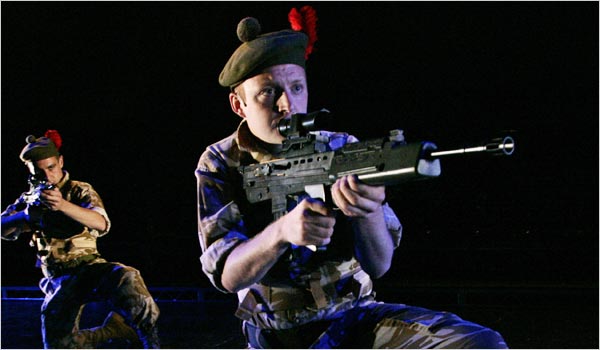 It is difficult to
know how to start with this one. There can be few people who do not start this
with an amount of baggage. Everyone will have views about Iraq, about the army,
about war in general. Many members of the audience will have families in Iraq or
Afghanistan, many, I suspect were former members of the Black Watch. The issues
raised are difficult for everyone. What this play does do, however, is take the
side of the 'poor bloody infantry'. The words are largely those of the Black
Watch, the incidents are real, the plot, if there is one, documentary. The story
telling, however is pure theatre, done at a high level of skill, imagination and
technique.
It is difficult to
know how to start with this one. There can be few people who do not start this
with an amount of baggage. Everyone will have views about Iraq, about the army,
about war in general. Many members of the audience will have families in Iraq or
Afghanistan, many, I suspect were former members of the Black Watch. The issues
raised are difficult for everyone. What this play does do, however, is take the
side of the 'poor bloody infantry'. The words are largely those of the Black
Watch, the incidents are real, the plot, if there is one, documentary. The story
telling, however is pure theatre, done at a high level of skill, imagination and
technique.
The writer meets a
number of former members of the Black Watch in a Glasgow pub. They are not easy.
Where's the fucking cunt you promised me? Where the fanny? Do you think we're
going to talk to a wanker like you, you cunt, you fucking cunt. Quietly he
does draw some stories form the group. As he does so the bar is transformed to
Camp Dogwood near Faludjah. The gr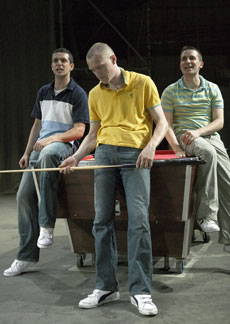 oup are living in their 'wagons' (Warrior
armed cars) in temperatures of up to 50 degrees. The Iraqis throw mortars at
them. Incessantly. They do not respond. No one knows what they are doing there.
Everyone is frustrated, some want to get out and see some action, some just wait
until they can get home. The Commander is just as frustrated I expect every
lunatic terrorist from miles around to descend on us like bees to honey (the
words of Lieutenant-Colonel James Cowan). Much of the action is banal. Petty
squabbles, pointless bragging, thinking about home, always punctuated by huge
explosions as everyone hurls themselves to the floor. I loved the old-timer who
recommends walking around with a piece of paper, so no-one ever challenges what
he is doing. As long as it looks official, he must be OK. An 'embedded
journalist' arrives, but not until the Sergeant major has removed all offending
porn from the walls of the wagon. The principal protagonist, Macca, is concerned
about fairness, and complains of 'bullying'. When the Americans spend four hours
ripping a small village to pieces and kill two civilians and a donkey it's not
right. It's bullying. No-one could have fought back through that.
oup are living in their 'wagons' (Warrior
armed cars) in temperatures of up to 50 degrees. The Iraqis throw mortars at
them. Incessantly. They do not respond. No one knows what they are doing there.
Everyone is frustrated, some want to get out and see some action, some just wait
until they can get home. The Commander is just as frustrated I expect every
lunatic terrorist from miles around to descend on us like bees to honey (the
words of Lieutenant-Colonel James Cowan). Much of the action is banal. Petty
squabbles, pointless bragging, thinking about home, always punctuated by huge
explosions as everyone hurls themselves to the floor. I loved the old-timer who
recommends walking around with a piece of paper, so no-one ever challenges what
he is doing. As long as it looks official, he must be OK. An 'embedded
journalist' arrives, but not until the Sergeant major has removed all offending
porn from the walls of the wagon. The principal protagonist, Macca, is concerned
about fairness, and complains of 'bullying'. When the Americans spend four hours
ripping a small village to pieces and kill two civilians and a donkey it's not
right. It's bullying. No-one could have fought back through that.
Interwoven with
these two themes is the Government's decision to abolish the Black Watch,
amalgamating it into other Scottish regiments. The localism of the Watch, the
'Golden thread', linking father and son across the communities from which
the Black Watch has drawn its number is threatened, and indeed belittled. Scorn
is poured n Geoff Hoon by Alex Salmond, the soldiers on the ground less
obviously bothered, but clearly showing their local roots and the generational
pull of the regiment. The best one can say is that it was insensitive, the
surprise that after so many cock-ups Geoff Hoon is actually still in cabinet.
Interestingly, the
violence of the group is far closer to the surface in the pub than in Iraq. In
the pub the anger of the group is menacing, volatile. At one point it spills
over as the writer almost has his arm broken so you know what it feels like.
And this bridges us into the final section the pointless death of three of the
group by a suicide bomber. This highly theatrical, slightly beautiful and
utterly dismaying moment is portrayed in ultra slow motion by actors on ropes
slowly descending through the chaos of the explo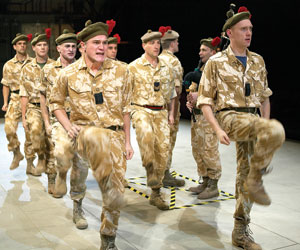 sion. Understandably the group
is distraught, but the more as it is so pointless. Why did the three die?
How could they have been defended? What is the point of it? It fits no pattern
makes no sense. These men who understand death do not understand these deaths.
In an eloquent scene Macca tells his commanding officer that he is going to
leave when he returns home. Begging your pardon, Sir, but why the fuck do you
stay? What are you dong here? The commander is as short of answers as
anyone else.
sion. Understandably the group
is distraught, but the more as it is so pointless. Why did the three die?
How could they have been defended? What is the point of it? It fits no pattern
makes no sense. These men who understand death do not understand these deaths.
In an eloquent scene Macca tells his commanding officer that he is going to
leave when he returns home. Begging your pardon, Sir, but why the fuck do you
stay? What are you dong here? The commander is as short of answers as
anyone else.
The play left me
feeling deeply depressed. Had it been a political polemic against the war, it
would have been limited in its effect, but this is as much about the communities
from which the soldiers come as the war, and as much about the effect on the
young men when they return as when they experienced the horrors of war. An
extraordinary proportion of the homeless on London's streets are ex-army,
men who do not know where they fit or how to function in 'normal' society. These
men are scarred irrevocably by their confused understanding of the war they
fought in, the war where they were targets and didn't know how to fight back. It
was so very positive about these victims in all the theatres, not just the front
line, and this gave it a tremendous power. Depressing, but important and a very,
very good play.
Return
to reviews
Return
to home page